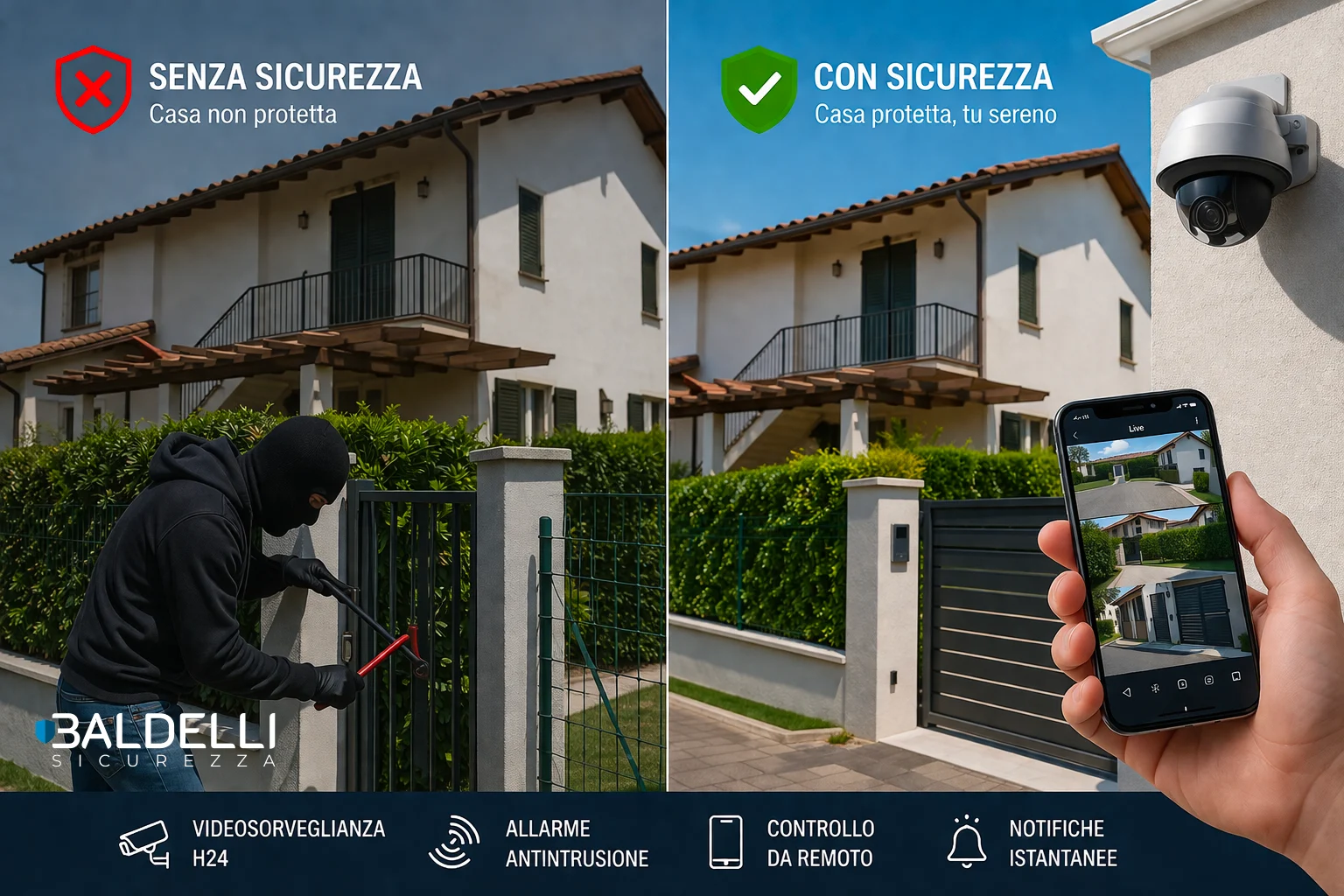

Protecting outdoor areas and boundaries is the first step in defending against intrusion attempts
Detecting intruders well before they enter a building is the main challenge for alarm manufacturers. Why call it a challenge? Because reliably detecting people outdoors is complex, and distinguishes a high-quality security system from a low-cost one.
The right response to outdoor challenges
Many outdoor events can make detection difficult. Consider fog, weather conditions or false alarms caused by unpredictable stray animals. Today’s technology offers many solutionsthat are increasingly effective, each with characteristics suited to its installation environment. Let us examine infrared barriers and outdoor detectors in particular.
Infrared barriers for perimeter protection
The barriers , consisting of a transmitter and receiver, are positioned at strategic points along boundaries, such as a garden perimeter, or near exterior doors and windows. An invisible infrared beam defines the protected area: when a foreign body crosses it, an immediate alarm is sent to the control panel. Latest-generation barriers are highly precise and work even in fog. A special function called “disqualification” identifies a gradual signal reduction and automatically associates it with fog.
Outdoor motion detectors for perimeter protection
The outdoor motion detectors, unlike barriers, detect movement and the presence of a warm body within their coverage area. As soon as an intruder enters, the detector immediately sends an alarm to the control panel. Latest-generation detectors combine several detection technologies: they are extremely precise and are not “fooled” by outdoor factors such as rain, moving branches or direct sunlight. Wired and wireless versions are available to reach difficult areas and can also be added to existing installations.
Technology is constantly evolving to provide increasingly effective solutions that reduce false alarms and keep danger outside the home.